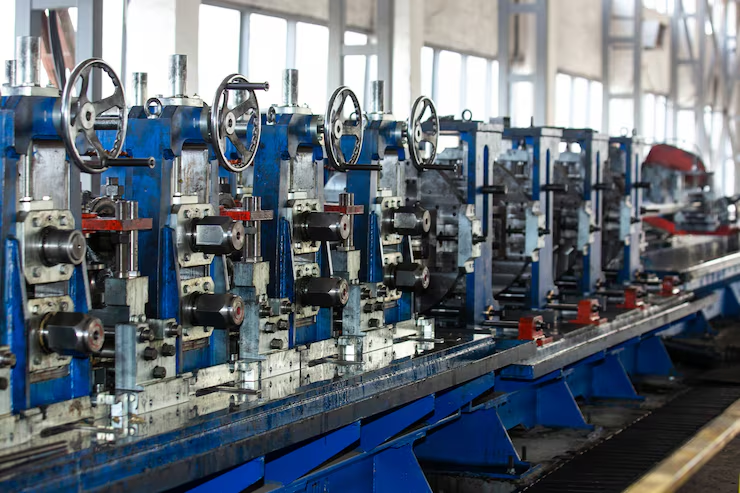
Look around the room you are sitting in right now. Look at the chair you are sitting on, the phone in your hand, or the car parked in your driveway. Have you ever stopped to wonder how these things actually exist? They did not just appear out of thin air. They were cut, molded, shaped, and assembled. Behind every single object in our modern lives is a massive, powerful, and often loud world of industrial machinery. These machines are the unsung heroes of our civilization. They take raw materials like chunks of iron, pools of plastic, and logs of wood, and they turn them into the useful products we rely on every single day.
For most people, industrial machinery looks like a confusing mess of wires, gears, and metal pipes. It can feel intimidating. But understanding how these machines work is not just for engineers or factory workers. In 2026, technology has made these machines smarter, safer, and more interesting than ever before. Whether you are a business owner looking to buy equipment, a student interested in how things are made, or just a curious person, this guide is for you. We are going to strip away the complicated technical jargon. We will use simple, plain English to explain exactly what industrial machinery is, how it works, and why it is the beating heart of the global economy.
Understanding the Backbone of Modern Manufacturing
Industrial machinery is a broad term that covers any machine used in the manufacturing process. Unlike the washing machine or toaster in your house, which are “consumer appliances,” industrial machines are designed to run all day, every day. They are built to be tough. They are built to be precise. And most importantly, they are built to do work that is impossible for a human to do by hand.
Think about a car engine. It is made of solid metal. To make the holes for the pistons, you need to drill into that steel with incredible force. A human with a hand drill could never do it. You need a machine that is heavier than the engine itself, anchored to a concrete floor, pushing a drill bit made of diamond or carbide. That is industrial machinery. It amplifies human strength. It allows us to cut steel like it is butter, to lift shipping containers like they are feather pillows, and to weave fabric faster than the eye can see. Without these machines, we would still be living in a time where everything was made slowly by hand, and simple things like nails or screws would be expensive luxuries.
The Different Types of Industrial Machines Explained
Because factories make so many different things, there are thousands of different types of machines. However, we can group them into a few simple categories based on what they actually do to the material. First, we have “Material Removal” machines. These are the sculptors. They take a block of material and cut away what isn’t needed. This includes lathes, milling machines, and drills. A lathe spins the metal around while a sharp tool shaves it down, perfect for making round things like baseball bats or table legs. A milling machine stays still while a spinning cutter carves shapes into it.
Next, we have “Forming” machines. These machines don’t cut; they bend and squash. A “press brake” is a giant machine that takes a flat sheet of metal and bends it into a box shape. A “forging press” slams a heavy hammer down on hot metal to shape it into a wrench or a sword. Then there are “Joining” machines. These put things together. This includes welding robots that melt metal to fuse it, or riveting machines that punch metal pins to hold airplane wings together. Finally, we have “Finishing” machines. These make things look pretty. They polish, paint, and sand the products so they are smooth and safe to touch. Understanding these categories helps you see that a factory is just a series of these steps happening one after another.
Hydraulics Pneumatics and Electric Power Sources
Industrial machines need a lot of power. You cannot just plug a giant metal press into a standard wall outlet and expect it to work. Engineers use three main types of power to move these heavy beasts: Hydraulics, Pneumatics, and Electricity. Understanding the difference is like understanding the difference between a diesel truck and a race car.
Hydraulics is the muscle of the industrial world. It uses liquid—usually oil—under high pressure. You have seen this on dump trucks or excavators; those shiny silver cylinders are hydraulic rams. Liquid cannot be squashed. If you push liquid into a cylinder, it pushes back with massive force. We use hydraulics when we need to crush cars, lift elevators, or bend thick steel. It is slow, but it is incredibly strong.
Pneumatics uses air. Instead of oil, we squeeze air into a tank and use that pressure to move things. Air is “squishy” (compressible), so it acts like a spring. Pneumatics is very fast and clean. We use it for things that need to move quickly back and forth, like a robotic arm picking up a box or a drill spinning really fast. It is not as strong as hydraulics, but it is much snappier. Finally, we have Electric motors. These are the most common. They use magnets and electricity to spin a shaft. They are clean, quiet, and very precise. In 2026, electric motors are replacing a lot of old hydraulic systems because they are better for the environment and easier to control with computers.
How CNC Technology Changed the Game
In the old days, a machinist had to stand in front of a lathe and turn the handles by hand. They had to measure everything with a ruler and squint to make sure they were cutting in the right place. It was an art form, but it was slow, and if the machinist was tired, they made mistakes. Then came the Computer.
CNC stands for “Computer Numerical Control.” It sounds fancy, but it just means a robot is turning the handles instead of a human. The human types a code into a computer. This code is like a recipe. It says: “Move 3 inches to the left. Spin at 5000 RPM. Cut 1 inch deep.” The computer reads this recipe and sends electrical signals to the motors on the machine.
The machine does exactly what it is told, down to a fraction of a human hair. And the best part? It can do it a million times in a row without getting bored. CNC changed everything. It allowed us to make complex shapes—like the curved blades inside a jet engine or the tiny case of a smartphone—that no human hand could ever make. Today, almost all modern industrial machinery is CNC. The operator is no longer a manual laborer; they are a programmer and a supervisor, watching the machine do the hard work.
Essential Maintenance Tips for Long Lasting Equipment
Industrial machines are expensive. A single high-end CNC mill can cost as much as a house. If you own one, you want it to last forever. The secret to longevity is maintenance. Just like you have to change the oil in your car, you have to take care of factory equipment. There are two ways to do this: Reactive Maintenance and Preventive Maintenance.
Reactive Maintenance is the “fix it when it breaks” strategy. This is a bad idea. If a machine breaks on a Tuesday morning, your whole factory stops. You have to pay for emergency shipping for parts, and your workers are standing around doing nothing. It costs a fortune.
Preventive Maintenance is the smart way. It means fixing things before they break. It involves a schedule. Every Monday, you check the oil levels. Every month, you tighten the belts. Every six months, you replace the filters even if they look clean. It also involves listening to the machine. A machine often talks to you before it dies. It might start making a whining noise, or vibrating more than usual, or getting hot. In 2026, we use “Predictive Maintenance.” We put sensors on the machines that connect to the internet. If a bearing starts to vibrate, the machine sends a text message to the maintenance manager saying, “Hey, I’m going to break in about three days, please come fix me.” This saves businesses millions of dollars in lost time.
Keeping Workers Safe Around Heavy Machinery
Industrial machines are powerful, and they do not have feelings. They do not know the difference between a piece of steel and a human finger. If you put your hand in the wrong place, the machine will crush it without slowing down. Safety is the number one priority in any facility involving heavy machinery.
The first line of defense is “Guarding.” This is a physical barrier. It might be a metal cage or a plastic shield that prevents you from touching the moving parts. You should never, ever remove a guard to speed up a job. The second defense is the “Emergency Stop” or E-Stop. This is the big red mushroom-shaped button you see on every machine. When you hit it, it cuts the power instantly. Everyone in the factory needs to know where these buttons are.
Modern safety uses invisible barriers called “Light Curtains.” These are beams of light that go across the opening of a machine. If you reach your hand through the beam, the machine detects the break in the light and stops instantly. It is like magic. We also use a procedure called “Lockout/Tagout.” When a mechanic is fixing a machine, they put a physical padlock on the power switch. They keep the key in their pocket. This ensures that nobody can accidentally turn the machine on while the mechanic is inside working on it. Safety isn’t just rules; it is a culture of respect for the power of these tools.
The Rise of Automation and Smart Factories in 2026
We are currently living through the “Fourth Industrial Revolution,” often called Industry 4.0. This is the era where machines stop being dumb tools and start being smart collaborators. In a traditional factory, a robot was kept in a cage because it was dangerous. Today, we have “Cobots,” or Collaborative Robots.
A Cobot is designed to work next to a human. It has sensors that can feel if it bumps into you. If it touches you, it stops immediately. This means a human and a robot can work on the same table. The robot lifts the heavy part and holds it steady, while the human does the delicate wiring. It is a partnership.
Smart factories also use the “Industrial Internet of Things” (IIoT). Every machine is connected to the Wi-Fi. The manager can look at a tablet and see exactly how fast every machine is running, how much energy it is using, and how many parts it has made today. This data helps factories run more efficiently. If one machine is running slow, the system can automatically slow down the others to prevent a traffic jam of parts. It is a seamless, digital ecosystem where the physical machinery and the digital software are completely integrated.
How to Choose the Right Equipment for Your Business
If you are starting a manufacturing business, buying machinery is the biggest investment you will make. It can be scary. How do you know what to buy? The biggest mistake people make is buying the biggest, fastest machine they can find. This is often a waste of money.
First, look at your “Cycle Time.” How fast do you actually need to make parts? If you only need to make 50 parts a day, you do not need a robot that can make 5,000. Buy the machine that fits your current needs, not your fantasy needs. Second, look at support. A machine is useless if you can’t get parts for it. Buy from a brand that has a service center in your country. If you buy a cheap machine from overseas with no support, and a $5 part breaks, your machine becomes a giant paperweight for weeks while you wait for shipping.
Also, consider the “Total Cost of Ownership.” A machine might be cheap to buy, but expensive to run. Does it use a lot of electricity? Does it require expensive specialized oil? Does it need a dedicated employee just to watch it? Sometimes, spending more money upfront for a high-quality, efficient machine saves you money in the long run. Talk to other people in your industry. Ask them what they use. The best advice comes from the people who are already getting their hands dirty.
Troubleshooting Common Machinery Problems
Even the best machines break. When they do, you need to be a detective. Troubleshooting is a logical process. You start with the simple things and move to the complex things. The number one rule of troubleshooting is: “Check the simple stuff first.”
Is it plugged in? Is the air compressor turned on? Did someone hit the Emergency Stop button by accident? You would be surprised how often a “broken” machine is just unplugged. Next, listen to the machine. A grinding noise usually means a bearing is bad. A hissing noise usually means an air leak. A burning smell usually means an electrical motor is overheating.
If the machine is doing something weird, look at the “Variables.” What changed? Did you buy a new batch of raw material? Is the factory hotter than usual today? Did a new operator start working on it? Often, the machine is fine, but the environment has changed. Finally, use the manual. Every machine comes with a book full of error codes. If the screen says “Error 404,” look it up. The engineers who built the machine wrote that book to help you. Don’t guess; read the instructions.
The Future of Industrial Engineering and Sustainability
For a long time, industrial machinery was seen as dirty and polluting. Big smokestacks and leaking oil were just part of the job. In 2026, that is changing. The future of machinery is Green. Companies are realizing that wasting energy is wasting money.
New electric motors are incredibly efficient. They use a fraction of the power of old motors. We are also seeing a move towards “Dry Machining.” Traditionally, cutting metal required gallons of oil to keep it cool. Now, we have special coatings on drill bits that allow them to cut dry, eliminating the need for messy, toxic chemicals.
Sustainability also means building machines that last. The “Right to Repair” movement is hitting the industrial world. Business owners are demanding machines that can be fixed easily with standard tools, rather than machines that are glued together and have to be thrown away when they break. We are also seeing machines made from recycled materials. The goal is a “Circular Economy,” where old machines are melted down to make new machines, and nothing goes to a landfill. Industrial machinery built the modern world, and now, it is evolving to save it. By making our factories cleaner, safer, and more efficient, these incredible machines will continue to power our lives for generations to come.