Have you ever wondered how the traffic lights know exactly when to turn green just as you arrive at the intersection? Or how your air conditioner knows to turn off the moment your room hits the perfect temperature? Or perhaps you have stood in a factory and watched a robotic arm place a label on a bottle with pinpoint accuracy, thousands of times an hour. We live in a world that seems to run on magic. Things happen automatically, precisely, and reliably. But it is not magic. It is the result of a fascinating field of engineering called Automation and Control Systems.
For most people, these systems are invisible. They hide behind walls, inside machines, and under the hoods of our cars. But in 2026, they are the heartbeat of our civilization. Without them, our power grid would fail, our water would stop flowing, and our factories would grind to a halt. Automation is the art of making things work without human help, and Control Systems are the brains that make sure they work correctly. This guide is going to walk you through this hidden world. We will strip away the complex math and engineering jargon and use simple, plain English to explain exactly how these systems think, act, and keep our world moving safely and efficiently.
Understanding the Basics: Inputs, Logic, and Outputs
To understand any control system, whether it is a nuclear power plant or a toaster, you only need to understand three simple concepts: Input, Logic, and Output. Think of your own body. If you touch a hot stove, your nerves send a signal (Input) to your brain. Your brain decides “This is hot, I should move” (Logic). Your brain sends a signal to your muscles to pull your hand away (Output).
Automation works the exact same way. Let’s look at an automatic door at a grocery store. The Input is a motion sensor above the door. When you walk toward it, the sensor “sees” you and sends an electrical signal. The Logic is a small computer controller hidden in the ceiling. It receives the signal and follows a simple rule: “If motion is detected, open the door.” The Output is the electric motor connected to the door. The controller sends power to the motor, and the door slides open.
This loop happens millions of times a day in machines all over the world. The sophistication comes from how complex the Logic is. A simple system might just turn on and off (like a light switch). A complex system might monitor temperature, pressure, and speed all at once and make tiny adjustments every millisecond to keep a chemical reaction stable. But at the core, it is always about sensing the world, thinking about it, and then changing it.
The Brain of the Factory: Programmable Logic Controllers (PLCs)
If you walked into a factory fifty years ago, you would have seen giant walls covered in thousands of electrical relays and messy wires. If you wanted to change how a machine worked, you had to physically rewire the wall. It was a nightmare. Then came the PLC, or Programmable Logic Controller. This is the single most important invention in the history of automation.
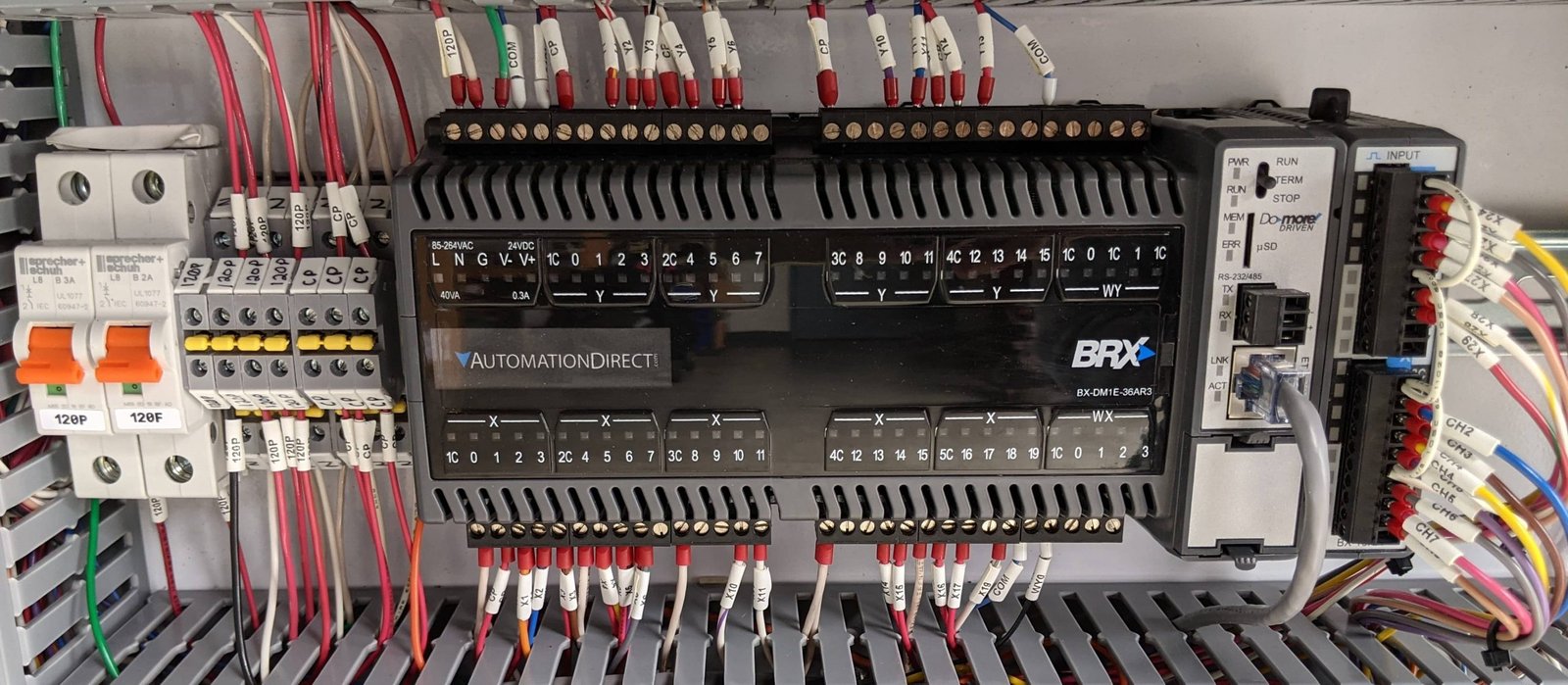
Think of a PLC as a rugged, industrial computer. It doesn’t have a keyboard or a screen like your laptop. It is usually just a gray box inside a metal cabinet. But unlike your laptop, a PLC is built like a tank. It can survive in a factory that is hot, dusty, vibrating, and noisy. It never freezes, it never asks for a Windows update in the middle of a job, and it processes information incredibly fast.
In a modern factory, the PLC is the boss. It is connected to every sensor and every motor. A programmer writes a code on a laptop and uploads it to the PLC. This code tells the PLC exactly what to do. For example, “When the bottle passes the sensor, wait 0.5 seconds, then fire the label gun.” If the factory needs to change the bottle size, they don’t need to rewire the building; they just plug in a laptop and change the code. PLCs are the reliable, uncomplaining brains that run everything from roller coasters to car assembly lines.
The Eyes and Ears: Sensors and Feedback Loops
A brain is useless if it cannot sense the world around it. You cannot drive a car with your eyes closed. In automation, we use “Sensors” to give the PLC eyes and ears. There are thousands of different types of sensors, each designed to measure a specific thing.
You have Proximity Sensors, which can tell if an object is nearby without touching it. These are used on assembly lines to count products. You have Temperature Sensors (thermocouples) that measure heat inside an oven. You have Pressure Sensors that monitor the flow of liquids in pipes. You even have complex Vision Systems—cameras that take a picture of a product and use software to check if the label is crooked or the cap is loose.
The magic happens when you combine sensors with logic to create a “Feedback Loop.” Imagine you are driving a car and you want to stay at 60 mph. You press the gas pedal (Output). You look at the speedometer (Sensor). If you are going 55 mph, you press harder. If you go 65 mph, you let off. You are constantly adjusting based on feedback. This is a “Closed Loop” system. An “Open Loop” system would be putting a brick on the gas pedal and hoping for the best. Almost all modern automation uses closed loops to ensure high precision and safety.
Making Things Move: Actuators and Drives
Once the PLC decides what to do, it needs muscles to actually do it. These muscles are called “Actuators.” An actuator is anything that converts energy into motion. The most common actuator is the Electric Motor.
Motors are everywhere. They spin conveyor belts, pump water, and power robotic arms. But you can’t just plug a giant industrial motor into the wall; it would spin at full speed instantly and break everything. You need a way to control it. This is where “Drives” (or VFDs – Variable Frequency Drives) come in. A Drive is a device that sits between the power source and the motor. It acts like a dimmer switch for a light bulb.
The PLC tells the Drive, “Run the motor at 50% speed.” The Drive adjusts the electricity going to the motor to make it spin at exactly half speed. If the load gets heavier (like a heavy box falls on the conveyor), the Drive senses the strain and adds more power to keep the speed constant. Besides motors, we also use Pneumatic Cylinders (using compressed air to push things back and forth) and Hydraulic Rams (using oil pressure for heavy lifting). These are the hands and legs of the machine, doing the physical work that humans used to do.
The Art of Smooth Control: PID Loops Explained Simply
Have you ever tried to keep a pot of water at a perfect simmer? If you turn the heat up high, it boils over. If you turn it down, it stops bubbling. You have to constantly fiddle with the knob to find the sweet spot. This is a control problem. In automation, we use a mathematical formula called PID (Proportional-Integral-Derivative) to solve this automatically.
Don’t let the math scare you. Think of it like driving a car and trying to stop at a red light.
- Proportional (P): This looks at where you are right now. You see the red light far away, so you start braking. The closer you get, the harder you brake. But if you only use P, you might stop a little short or a little late.
- Integral (I): This looks at the past. It asks, “Have I been stopping too slowly for a long time?” If you are dragging your feet, the ‘I’ term adds extra pressure to get you to the line faster. It corrects the small errors that accumulate over time.
- Derivative (D): This looks at the future. It predicts what is about to happen. If you are braking too hard and you are about to slam your nose into the steering wheel, the ‘D’ term eases off the brake right at the end for a smooth stop.
When you combine P, I, and D, you get a system that reacts fast, stays accurate, and is incredibly smooth. Your cruise control, your drone’s stability, and your thermostat all use PID loops to keep things steady without jerking around.
Seeing the Big Picture: SCADA and HMI
A factory might have 500 different PLCs, thousands of sensors, and miles of conveyor belts. How does a human manager know what is going on? They cannot run around checking every wire. They need a dashboard. This is called SCADA (Supervisory Control and Data Acquisition) and HMI (Human Machine Interface).
An HMI is usually a touchscreen panel attached to a machine. It looks like an iPad. It shows the operator what that specific machine is doing. It has buttons to Start, Stop, and adjust settings. Instead of physical buttons that break, it uses digital buttons on a screen.
SCADA is the big brother. It is a computer system in a control room that looks at the entire factory at once. Imagine a giant screen showing a map of the plant. Green lights mean machines are running; red lights mean they are stopped. The manager can sit in a chair and see that Pump #4 in the basement is overheating, or that Line #2 is running slower than Line #1. SCADA records data over time, allowing businesses to look back and say, “Why was production low last Tuesday?” It turns invisible electricity into visible, useful information.
The Nervous System: Industrial Communication Networks
In the old days, every sensor had a wire that ran all the way back to the PLC. If you had 1,000 sensors, you had a bundle of copper wire as thick as a tree trunk. It was expensive and hard to fix. Today, automation uses digital networks.
Just like your home has Wi-Fi and Ethernet to connect your phone and TV, factories have “Fieldbuses.” These are industrial networks like Ethernet/IP or PROFINET. Instead of a thousand wires, you run one single yellow cable that connects to everything in a line.
The sensor sends a digital message down the cable: “I am Sensor #5 and I see a box.” The PLC listens to the cable and hears the message. This allows machines to talk to each other. A robot can tell a conveyor belt, “I am busy, stop sending boxes.” A furnace can tell a fan, “I am getting hot, speed up.” In 2026, we are even seeing 5G wireless networks in factories, allowing robots to move around freely without any cables attached at all. This “Industrial Internet of Things” (IIoT) means that every part of the factory is constantly chatting, sharing data, and optimizing itself.
Safety Systems: Protecting People from Machines
Automation is powerful, but it can be dangerous. A robotic arm moves fast and hits hard. It does not know the difference between a piece of steel and a human arm. That is why “Safety Integrated Systems” are a critical part of control engineering.
We use special yellow safety components that are designed to never fail. The most common is the E-Stop (Emergency Stop). This is the big red mushroom button you see on every machine. When you hit it, it physically cuts the power to the motors. It overrides everything else the computer is trying to do.
We also use Light Curtains. These are invisible beams of light that act like a fence. If a human reaches their hand through the light beam to fix a jam, the machine stops instantly. We use Safety Mats on the floor that detect if someone is standing too close. The Logic for safety is separate from the normal Logic. Even if the main PLC crashes or gets a virus, the Safety System is hard-wired to work no matter what. In modern automation, human safety is the number one priority, and the control systems are designed to protect us from our own mistakes.
The Future of Control: AI and Self-Healing Machines
Where is all this going? The future of automation is “Adaptive Control.” Right now, we have to program the PLC. We have to tell it exactly what to do. If something unexpected happens—like the wood we are cutting is wetter than usual—the machine might struggle.
In the future, Artificial Intelligence (AI) will allow machines to learn. A machine will run for a week and realize, “Hey, every time the temperature drops, the paint gets too thick. I should automatically add more thinner when it’s cold.” It will optimize itself without a human programmer.
We are also seeing “Self-Healing” systems. If a sensor breaks today, the machine stops. In the future, the system might say, “Sensor A is broken, but I can use the data from Sensor B and C to guess what Sensor A would have seen,” and keep running until a human can fix it. Automation is moving from simply following orders to actually understanding the job.
Conclusion: The Silent Partner in Our Lives
Automation and Control Systems are the silent partners in modern life. They purify our water, package our food, assemble our cars, and keep our lights on. They take the drudgery out of work, handling the repetitive, dangerous, and boring tasks so that humans can focus on creativity and problem-solving.
Understanding these systems removes the fear of technology. They are not taking over; they are tools we have built to amplify our own abilities. A PLC is just a lever for the mind. A sensor is just an extension of our senses. As we move forward into 2026 and beyond, these systems will become smarter and more integrated, but their purpose remains the same: to create a world that works smoothly, efficiently, and safely for everyone. So the next time the automatic doors slide open for you, take a second to appreciate the invisible loop of Input, Logic, and Output that made it happen. It is a small miracle of engineering, happening right in front of you.