If you watched science fiction movies twenty years ago, you probably imagined that by 2026, we would have flying cars and robot butlers doing our laundry. While the flying cars are still a work in progress, the robot revolution has definitely arrived, just not in the way Hollywood predicted. It didn’t happen with a bang or a war against machines. Instead, it happened quietly in our factories, our warehouses, and our hospitals. It happened one smart sensor and one helpful robotic arm at a time.
Today, Artificial Intelligence (AI) and Robotics are the power couple of the industrial world. They are changing how we make things, how we move things, and even how we fix things. For a long time, people were afraid of this change. The headlines were always scary: “Will Robots Take Your Job?” or “The End of Human Labor.” But now that we are living in this future, we can see the reality is much more positive. The robots didn’t come to replace us; they came to help us. They came to take over the jobs that are boring, dirty, and dangerous, leaving humans free to do the work that requires creativity and problem-solving. This guide is going to walk you through exactly how AI and robotics are transforming industry right now. We will strip away the confusing tech jargon and use simple, plain English to explain why this is the most exciting time in history to build things.
Cobots: Why Your Next Coworker Might Be a Robot
For decades, industrial robots were scary beasts. They were massive, heavy, and moved with incredible speed and force. If a human got in their way, the robot wouldn’t stop. It would crush them. Because of this, robots were kept in cages. The factory floor was divided: humans on this side, robots on that side. They never touched, and they never worked together.
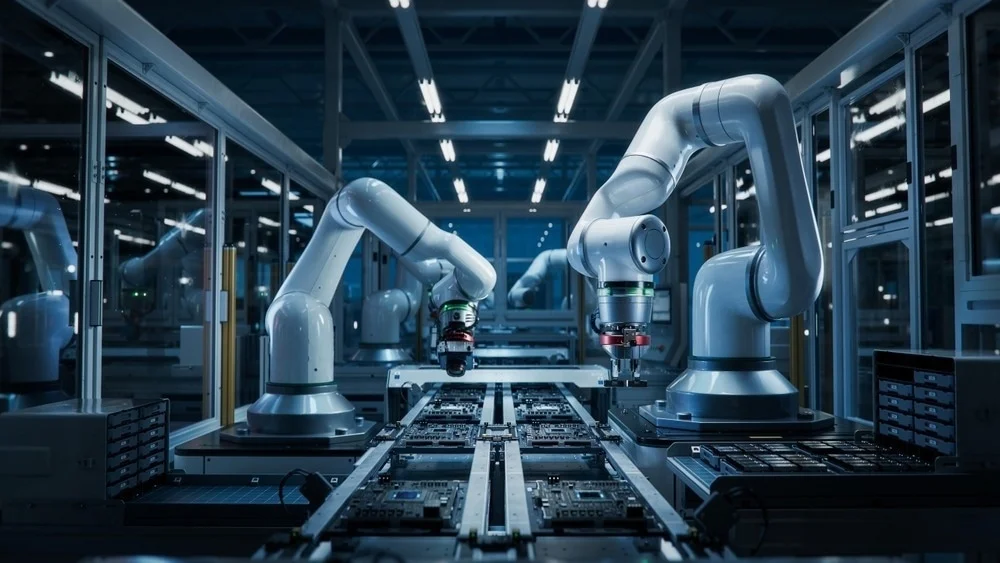
In 2026, those cages are coming down thanks to “Cobots,” or Collaborative Robots. A cobot is a robot designed specifically to work next to a human being. They look different—usually smaller, rounder, and friendlier. But the real magic is inside. They are covered in sensors that act like a digital skin. If a cobot bumps into your arm while you are working, it feels the impact and stops instantly. It is safe.
This safety changes everything. It means a human and a robot can share a workbench. Imagine you are packing boxes. The cobot lifts the heavy item and holds it in the air for you. You inspect it, put the label on, and then the robot places it in the box and tapes it shut. The robot acts as a super-strong third arm. It takes the physical strain off your back. You don’t have to lift 50 pounds every two minutes anymore; the robot does the lifting, and you do the thinking. This partnership is making factory work safer and much less exhausting for millions of people.
Predictive Maintenance: Fixing Machines Before They Even Break
There is nothing more frustrating for a business owner than a machine breaking down. In the old days, we practiced “Run-to-Failure.” You ran the machine until smoke came out, and then everyone stood around for three days while a mechanic tried to fix it. It was expensive and stressful. Then we moved to “Preventive Maintenance,” which is like changing the oil in your car every 3,000 miles whether it needs it or not. It was better, but we were still throwing away good parts just to be safe.
Now, AI has given us “Predictive Maintenance.” This is the ability to see into the future. We stick tiny sensors on our machines—pumps, motors, conveyor belts—that listen to them 24/7. These sensors measure vibration, heat, and sound.
A human ear can’t hear a bearing starting to wear out inside a giant motor, but an AI sensor can. The AI analyzes the data and notices a tiny change in the vibration pattern. It sends a text message to the manager: “Hey, Motor #4 is going to fail in about 48 hours.” This is a game-changer. The maintenance team can now fix the motor during a scheduled lunch break. They order the part ahead of time. The factory never stops unexpectedly. It saves billions of dollars a year and stops those panic-filled moments where production grinds to a halt.
Quality Control: How AI Eyes See What Humans Miss
Human beings are amazing, but we are not consistent. If you ask a person to inspect 5,000 smartphone screens for scratches, they will do a great job for the first hour. By the fourth hour, their eyes will be tired. By the eighth hour, they will be missing defects because they are bored and exhausted. It is just human nature.
Robots do not get bored. They do not get tired, and their eyes never blink. This is why “Computer Vision” has taken over quality control. We set up high-definition cameras on the assembly line connected to an AI brain. As products fly by—sometimes hundreds per minute—the AI takes a picture of every single one.
The AI compares the picture to a “perfect” version. It can spot a scratch that is thinner than a human hair. It can see if a label is crooked by one millimeter. It can check if a screw is missing inside a complex engine. If it sees a defect, it instantly triggers a robotic arm to kick that bad part off the line into a reject bin. This ensures that every single product that leaves the factory is perfect. It reduces waste because we catch the mistake immediately, rather than letting a bad part ruin a whole batch.
The Safety Revolution: Sending Robots into the Danger Zone
There is an old saying in the robotics industry: robots are built for the “Three Ds”—the Dull, the Dirty, and the Dangerous. There are some jobs that humans simply shouldn’t be doing in 2026 because the risk is too high.
Think about a chemical plant where toxic fumes are in the air. Or a foundry where molten metal is poured at 2,000 degrees. Or a nuclear power plant that needs inspection. In the past, humans had to put on heavy protective suits and risk their health to do these jobs. Now, we send the robots.
We have robots on tracks that can drive into burning buildings to check for survivors. We have drones that fly inside giant oil tanks to look for cracks so a human doesn’t have to dangle on a rope. We have robotic arms that handle radioactive waste. By using robots as avatars, we keep human workers out of harm’s way. The human sits in a comfortable, air-conditioned control room miles away, controlling the robot with a joystick. They use their expertise to make decisions, but their body is safe. This is the greatest moral achievement of industrial robotics: saving lives.
Supply Chain Management: AI Predicting the Future of Logistics
We all love ordering something online and having it arrive the next day. But have you ever wondered how that is possible? It is a miracle of logistics, powered by AI. The supply chain—the journey a product takes from the factory to your door—is incredibly complex. It involves ships, trucks, trains, and warehouses.
AI acts as the brain of this giant network. It looks at massive amounts of data to predict what people will buy before they even buy it. For example, an AI system might notice that it is getting cold in Chicago. It looks at history and sees that people buy winter coats when the temperature drops below 40 degrees. So, it tells the warehouse in Ohio to ship 5,000 coats to the warehouse near Chicago today.
By the time you click “Buy” on your phone, the coat is already sitting in a truck ten miles from your house. This is called “Anticipatory Shipping.” Inside the warehouse, swarms of small orange robots move shelves around. Instead of a human walking miles down aisles to find your item, the robot picks up the whole shelf and brings it to the human packer. It is a dance of efficiency that makes modern e-commerce possible.
The Skills Gap: Why We Need More Human Brains Than Ever
When people talk about robots, the conversation always turns to jobs. “Will a robot take my job?” The answer is yes and no. Robots are definitely taking tasks—specifically the repetitive, boring tasks like tightening screws or stacking boxes. But they are creating new jobs that are much more interesting.
We are currently facing a “Skills Gap.” We have plenty of robots, but we don’t have enough humans who know how to manage them. We need “Robot Shepherds”—people who can set up, program, and repair these machines. We need data analysts who can look at the information the sensors are collecting and make sense of it.
The factory worker of 2026 is not a manual laborer; they are a technician. They walk around with a tablet, monitoring the fleet of robots. They use their problem-solving skills to improve the process. This means education is more important than ever. Companies are investing heavily in training their staff. A guy who used to lift heavy boxes is now being taught how to program the robotic arm that lifts the boxes. The work is becoming less physical (brawn) and more mental (brain). It is a shift that requires effort, but it leads to higher-paying and more satisfying careers.
Smart Factories: When Machines Talk to Each Other
Imagine a factory where the machines talk to each other like a team of people. This is the concept of the “Industrial Internet of Things” (IIoT). In the old days, machines were islands. The drill didn’t know what the saw was doing. Today, everything is connected to the internet.
Let’s say a machine in the middle of the assembly line slows down because a drill bit is getting dull. In a dumb factory, the machines before it would keep piling up parts, creating a traffic jam. In a Smart Factory, the slow machine sends a message to the machines behind it: “Hey guys, I’m slowing down, so you should slow down too.” The whole line automatically adjusts its speed to match.
The sensors also talk to the ventilation system. If a welder starts producing more smoke than usual, it tells the fans to spin faster to clear the air. If the factory floor is empty at night, the lights turn themselves off to save energy. This interconnected web creates a factory that runs like a living organism. It reacts to changes instantly. It saves energy, reduces waste, and makes the whole production process smoother.
The Cost of Automation: Is It Affordable for Small Business?
For a long time, robotics was a game for the giants. Only massive companies like Toyota, General Motors, or Amazon could afford the millions of dollars it cost to buy robots. A small family-owned machine shop or a local bakery couldn’t dream of automating. They were stuck doing things the old way.
That barrier has crumbled. The cost of robots has dropped dramatically in the last ten years. But more importantly, the business model has changed. We now have “Robots as a Service” (RaaS). Instead of buying a robot for $50,000, a small business can rent one for an hourly rate, just like hiring a temp worker.
This democratizes technology. A small bakery can rent a robot to ice cakes during the busy holiday rush and then return it in January. A small metal shop can afford a cobot arm to load a machine, allowing their single human operator to run three machines at once instead of one. This helps small businesses compete with the big guys. It allows them to grow without taking on massive debt. In 2026, you will find robots in the back of pizza shops and local breweries, not just in giant car plants.
Conclusion: Embracing a Future of Human-Robot Collaboration
As we look around the industrial landscape of 2026, it is clear that the fear of a “robot takeover” was misplaced. Robots haven’t replaced us; they have elevated us. They have taken the heavy loads off our backs. They have taken the toxic fumes out of our lungs. They have taken the boredom out of our days.
We are entering an era of collaboration. The future isn’t “Human vs. Machine.” It is “Human + Machine.” When you combine the strength and precision of a robot with the creativity and judgment of a human, you can achieve things that neither could do alone. We can build higher quality products, we can deliver them faster, and we can do it all while keeping our workers safe and healthy.
The challenge now is to keep learning. The technology will keep moving forward, and we must move with it. By embracing these tools—by learning to work alongside our digital coworkers—we are building a world that is more efficient, more sustainable, and ultimately, more human. The robots are here to stay, and they are the best tools we have ever invented.