Have you ever stopped to look at the smartphone in your hand, the car you drive to work, or even the chair you are sitting on right now? We use thousands of objects every single day, but we rarely think about where they come from. We buy them from a store or order them online, and they just appear. But behind every single physical object in our lives is a fascinating, complex, and often noisy world of production and assembly. It is a world of moving conveyor belts, robotic arms, skilled human hands, and precise planning.
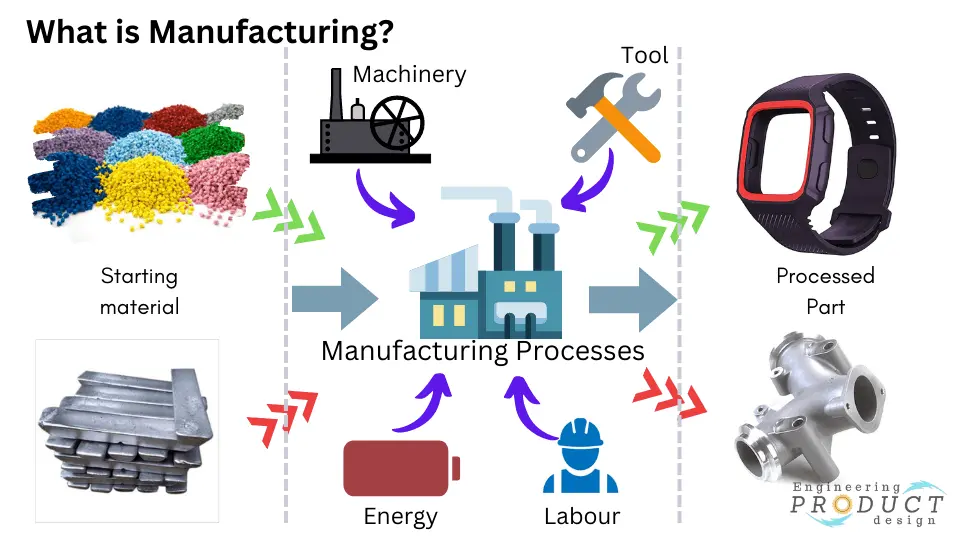
Manufacturing is the backbone of our modern society. It is the process of taking raw materials—like metal, plastic, wood, and glass—and turning them into something useful. It sounds simple, but when you have to make a million iPhones that all look exactly the same and work perfectly, it becomes a massive challenge. In 2026, the way we make things has changed. We have smarter machines, cleaner factories, and faster processes than ever before. This guide is going to walk you through the incredible journey of production. We will break down the complex jargon into simple English so you can understand exactly how the world around you is built.
The Journey From Raw Materials to Finished Goods
Every product starts its life as something else. Your car started as iron ore in the ground and oil deep beneath the ocean. Your wooden table started as a tree in a forest. The first stage of production is gathering these raw materials. This is often the messiest and most difficult part of the process. Companies have to mine, harvest, or recycle materials to get the basic building blocks they need.
Once the raw materials are gathered, they are processed. You cannot build a car out of iron ore; you need steel. So, the ore is melted down in giant furnaces, mixed with carbon, and rolled into sheets. Plastic pellets are melted and molded into shapes. Wood is cut and sanded. This stage is called “fabrication.” It is where the individual parts of a product are created. Think of it like cooking. You have to chop the vegetables and marinate the meat before you can actually cook the meal. In a factory, fabrication is the chopping stage. It is about preparing the ingredients so they are ready to be put together.
Mass Production Versus Custom Manufacturing
Not all factories work the same way. There are generally two main ways to make things: mass production and custom manufacturing. Mass production is what we usually think of when we imagine a factory. It is the process of making the exact same item over and over again, thousands or millions of times. Think of a soda can. Every soda can is identical. This method is great because it is fast and cheap. When you make a million items, the cost of each one goes down.
On the other hand, we have custom manufacturing. This is when a product is made specifically for one person. Think of a tailored suit or a custom kitchen cabinet. The carpenter measures your specific kitchen and builds the cabinets to fit only your house. This process takes much longer and costs more money, but the quality is usually higher, and the customer gets exactly what they want. In recent years, we have seen a blend of these two worlds. For example, when you buy a car, you might pick the color and the interior leather. The car is mass-produced, but your specific order is customized. This is called “mass customization,” and it is becoming very popular as technology gets better at handling unique requests.
The Heart of the Factory: The Assembly Line
The assembly line is perhaps the most famous invention in the history of manufacturing. Before assembly lines, one person would build an entire product from start to finish. If you wanted a shoe, a cobbler would measure your foot, cut the leather, stitch it, and glue the sole. This took a long time. Henry Ford is famous for changing this with his car factories. He realized that if you broke the job down into tiny steps, you could go much faster.
On an assembly line, the product moves, and the workers stay still. The car chassis moves down a conveyor belt. One worker puts on the left wheel. The next worker puts on the right wheel. The next worker tightens the bolts. Because each worker only has to do one simple task, they get very fast at it. They don’t have to walk around looking for tools. Today, assembly lines are incredibly sophisticated. They can move at different speeds, and they can even handle different products on the same line. You might see a red sedan followed by a blue truck on the same belt, and the system knows exactly which parts to bring to the workers for each vehicle.
The Rise of Robots and Automation in Factories
If you walked into a modern car factory today, the first thing you would notice is the robots. They are everywhere. Huge orange or yellow arms swing around with incredible speed and precision. They weld metal, paint car bodies, and lift heavy glass windshields as if they were feathers. Automation has completely changed production.
Robots are great at the jobs that humans are bad at. Humans get tired. We get backaches from lifting heavy things. We get bored doing the same repetitive motion for eight hours. We make mistakes when we are tired. Robots do not. A welding robot can make the exact same weld, down to the millimeter, twenty-four hours a day, seven days a week. This makes products safer and cheaper. However, there is a misconception that robots have replaced everyone. They haven’t. They have just changed the jobs. Instead of lifting heavy tires, humans are now programming the robots, fixing them when they break, and doing the detailed work that requires a human touch, like checking the quality of the leather seats or connecting delicate wires.
Just in Time: The Art of Efficiency
One of the biggest problems in manufacturing is storage. If you are building cars, you need thousands of parts: engines, tires, steering wheels, radios, and seats. In the old days, factories would have giant warehouses filled with months’ worth of parts “just in case” they needed them. This was expensive. You had to pay for the warehouse, pay people to guard it, and if the car design changed, all those old parts became trash.
Today, most factories use a system called “Just in Time” (JIT). The idea is simple: don’t store anything. Instead, have the parts arrive at the factory at the exact moment you need them. It is a logistical ballet. A truck carries the seats for today’s cars and arrives at the loading dock at 8:00 AM. By 9:00 AM, those seats are installed in cars. By 10:00 AM, the truck is gone. This saves massive amounts of money and space. However, it requires perfect timing. If the truck gets stuck in traffic or there is a snowstorm, the entire factory has to stop because there are no seats. It is a high-risk, high-reward way of working that keeps prices low for consumers.
Quality Control: Ensuring Perfection Every Time
Making a product is only half the battle. The other half is making sure it actually works. This is where Quality Control (QC) comes in. Imagine buying a new TV, taking it home, and finding out the screen is cracked. You would be angry, and you might never buy that brand again. Companies know this, so they spend millions testing their products before they leave the factory.
Quality control happens at every step. Raw materials are tested when they arrive to make sure the steel is strong enough. During assembly, cameras and lasers measure parts to make sure they fit together perfectly. If a door gap is one millimeter too wide, the line stops. Finally, there is end-of-line testing. Every car is driven on a test track. Every phone is turned on and checked to see if it can make a call. Sometimes, factories will take a random sample—say, one out of every hundred toasters—and test it until it breaks, just to see how long it lasts. This rigorous testing ensures that the product you buy is safe and reliable.
The Human Element in a High-Tech World
With all this talk of robots and computers, it is easy to forget about the people. But human beings are still the most important part of the production process. Machines are smart, but they are not creative. They cannot solve problems they haven’t been programmed for. If a machine jams or a part arrives with a weird defect, a human has to step in and figure it out.
Skilled labor is in high demand. Modern factory workers are not just turning wrenches; they are technicians. They read complex blueprints, they operate computer-controlled cutting machines (CNC), and they manage teams of robots. There is also the element of craftsmanship. In high-end products, like luxury watches or expensive guitars, machines cannot replicate the feel and finish that a master craftsman can achieve. The human hand is still the best tool for tasks that require delicate judgment and adaptability. The best factories are the ones that find the perfect balance, using robots for the heavy lifting and humans for the thinking.
Supply Chains and Logistics: Moving the Parts
Production does not happen in a bubble. It is part of a massive global web called the supply chain. Let’s look at a simple sneaker. The rubber for the sole might come from a tree in Malaysia. The cotton for the laces might be grown in India. The foam might be made in a chemical plant in Germany. All these parts have to travel thousands of miles to meet at a factory in Vietnam to be assembled.
Logistics is the science of moving these things around. It involves ships, trains, trucks, and planes. It is a miracle of coordination. A delay in a rubber plantation in Malaysia can stop a factory in Vietnam, which means a shoe store in New York runs out of stock. Managing this supply chain is incredibly difficult. Companies use advanced artificial intelligence to predict the weather, track ships across the ocean, and ensure that every shoelace arrives exactly when it is supposed to. When you hold a product, you are holding a piece of the world.
Sustainability and Green Manufacturing
For a long time, factories were seen as dirty, smoky places that polluted the environment. In 2026, that is changing fast. Sustainability is a huge priority for manufacturers. Companies are realizing that wasting energy and materials is not just bad for the planet; it is bad for business.
Green manufacturing involves using renewable energy, like solar or wind power, to run the factory. It means recycling water so it can be used again and again. It also means “Circular Economy” thinking. This is the idea that a product should be designed to be recycled. Instead of gluing a phone shut so it can never be opened, manufacturers are designing them so they can be easily taken apart. The gold, plastic, and glass can be harvested and turned into a new phone. This reduces the need to mine new materials. Many factories now aim for “Zero Waste to Landfill,” meaning that absolutely nothing from the factory ends up in a garbage dump. Everything is reused, recycled, or composted.
The Future of Production: 3D Printing and AI
What does the future hold for making things? The biggest game-changer is 3D printing, also known as Additive Manufacturing. Traditional manufacturing is “subtractive”—you take a block of metal and cut away what you don’t need, which creates waste. 3D printing is “additive”—you start with nothing and add material layer by layer until the object is finished. There is zero waste.
3D printing allows for shapes that were previously impossible to make. It allows a factory to print a spare part for a washing machine from 1990 on demand, rather than storing it in a warehouse for thirty years. Combined with Artificial Intelligence (AI), factories are becoming self-learning. An AI can monitor the production line, notice that a machine is vibrating slightly more than usual, and predict that it will break in three days. It can then order the replacement part and schedule the repair automatically. This leads to “Smart Factories” that run smoothly, quietly, and efficiently, producing the goods we need with minimal impact on the planet.
Conclusion
The world of production and assembly is a hidden miracle. It is a testament to human ingenuity and organization. From the raw earth to the finished product in your pocket, the journey is long and complex. It requires the strength of steel, the precision of robots, and the creativity of people. As we move forward, this process is becoming cleaner, smarter, and more efficient. The next time you pick up a coffee cup or start your car, take a second to appreciate the incredible coordinated effort it took to bring that object into your life. It really is a marvel of the modern world.