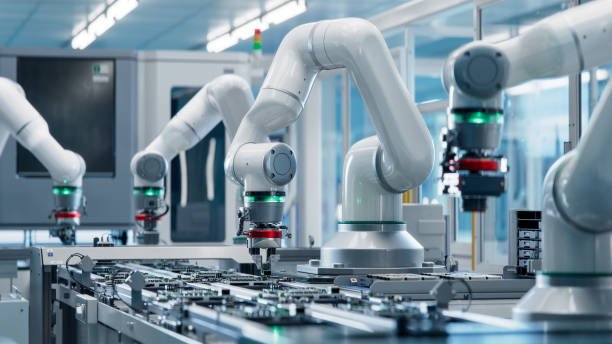
If you close your eyes and picture a factory, what do you see? For a long time, the image in our heads was dark, dirty, and incredibly loud. We imagined sparks flying, gears grinding, and rows of tired people doing the same repetitive motion over and over again for eight hours a day. It was a place of hard labor and heavy machinery. But if you walk into a modern manufacturing facility in 2026, you might think you have stepped onto the set of a science fiction movie. The floors are often white and spotless. The air is clean. It is surprisingly quiet. And while there are still people working, they aren’t tightening bolts or lifting heavy boxes. They are holding tablets, monitoring screens, and working side-by-side with intelligent machines.
This is the era of Automation and Robotics. It is not just a trend; it is a complete transformation of how we build everything, from the phone in your pocket to the car in your driveway. In the past few years, technology has moved faster than anyone expected. We have moved beyond simple machines that just stamp metal. We now have robots that can “see” with cameras, “feel” with sensors, and “think” with artificial intelligence. For many people, this change can feel a little scary. We worry about jobs and the human touch. But the reality is that automation is making manufacturing safer, faster, and surprisingly, more human-centric than ever before. This guide is going to walk you through this brave new world. We will strip away the complex engineering jargon and use simple English to explain how robots are building our future.
Understanding the Basics: What Are Industrial Robots?
When we hear the word “robot,” we often think of human-like androids from movies like Star Wars. But in the manufacturing world, a robot looks very different. The most common type is the “Articulated Arm.” Picture a human arm, but made of bright yellow or orange metal. It has a shoulder, an elbow, and a wrist. Instead of a hand with fingers, it has a tool attached to the end. This tool could be a gripper to pick things up, a welding torch to join metal, or a paint sprayer.
For decades, these robots were “dumb.” You had to program them with exact coordinates. You would tell the robot: “Move to point A, close gripper, move to point B, open gripper.” The robot would do exactly that, millions of times. However, if the part at point A was moved just one inch to the left, the robot would grab thin air, or worse, crash into the table. It had no idea what it was doing; it was just following a list of instructions.
In 2026, the game has changed. Modern industrial robots are equipped with vision systems. They have cameras and laser scanners that act as eyes. Now, you can dump a pile of random parts onto a table, and the robot can look at them, figure out which one is on top, determine the best way to grab it, and pick it up. This is called “bin picking,” and it is a huge leap forward. It means factories don’t need expensive equipment to line everything up perfectly before the robot touches it. The robot adapts to the mess, just like a human would.
Collaborative Robots: Meeting Your New Best Friend on the Factory Floor
One of the biggest shifts in the last five years is the rise of the “Cobot,” or Collaborative Robot. In the old days, industrial robots were dangerous. They were big, heavy, and moved incredibly fast. If a person got in the way, the robot wouldn’t stop. It would hit you with the force of a truck. Because of this, robots were kept in cages. They were fenced off from the human workers. It was “Humans here, Robots there,” and the two never met.
Cobots have torn down those fences. A cobot is designed specifically to work right next to a human being. They are usually smaller, lighter, and rounder, with no sharp edges. But the real magic is inside. They are filled with sensitive force sensors. If a cobot bumps into your arm while it is working, it feels the resistance and stops instantly. It is like bumping into a polite person in a hallway; they freeze and apologize.
This safety feature means that a worker and a robot can share a workbench. Imagine you are assembling a heavy piece of equipment. The cobot can lift the heavy engine block and hold it steady in the air, taking the weight off your back. Meanwhile, you use your skilled human hands to install the delicate wiring and small screws. The robot acts as a super-strong, tireless assistant. It hands you tools, holds parts, and does the boring stuff, allowing you to focus on the tricky parts. This partnership is redefining factory work, making it less physically demanding and much more efficient.
The Brains of the Operation: How AI is Powering Modern Machines
If the robotic arm is the body, Artificial Intelligence (AI) is the brain. In the past, programming a robot required a highly paid engineer to write thousands of lines of complex code. It took weeks to set up a robot to do a simple task. If you wanted the robot to do something new, you had to call the engineer back and pay them again. This made automation too expensive for small businesses.
Today, AI has made robots smart enough to learn on their own. We now have “Lead-through Programming.” Instead of typing code, a worker can simply grab the robot arm, move it to the right spot, and press a button that says “Save.” You show the robot the motion, just like you would show a new employee. The AI remembers the path and refines it to be smoother and faster.
Furthermore, AI allows robots to make decisions. In quality control, for example, a robot with a camera can inspect products as they fly by on a conveyor belt. The AI has been trained on thousands of images of “good” products and “bad” products. It can spot a microscopic scratch or a missing label in a fraction of a second—much faster than a human eye. If it sees a defect, it uses an air jet to blast that part off the line. It doesn’t get tired, and its attention never wanders. This ensures that the products you buy are perfect every single time.
Safety First: How Robots Protect Humans from the 3Ds
There is a saying in the manufacturing industry that robots are best suited for the “Three Ds”: the Dull, the Dirty, and the Dangerous. These are the jobs that humans really shouldn’t be doing anymore.
Think about a job like welding inside a ship’s hull. It is cramped, hot, and the air is filled with toxic fumes. Or think about painting cars. The paint fumes are hazardous, and the repetitive motion of spraying can cause serious shoulder injuries. Or consider a foundry where metal is melted at thousands of degrees. These are environments where a single mistake can kill or maim a person.
By replacing humans with robots in these specific areas, we are saving lives. A robot can weld all day in a cloud of smoke and not get sick. It can lift a 100-pound tire every minute without throwing out its back. It can reach into a furnace without getting burned. Automation allows us to move human workers out of the danger zone. Instead of breathing fumes, the welder becomes a “Robot Operator,” monitoring the machine from a safe, air-conditioned control room. They are still using their knowledge of welding to check the quality, but their body is no longer at risk. This is the greatest ethical argument for automation: it preserves human health.
Precision and Speed: The Unmatched Efficiency of Machines
Humans are amazing creatures. We are creative, adaptable, and dexterous. But we are not consistent. If you ask a person to drill a hole in the exact same spot 1,000 times, they will eventually miss. They might get tired, get distracted by a phone notification, or just have a bad day. Our energy levels go up and down.
Machines do not have bad days. A robot will drill that hole in the exact same spot, to within a fraction of a millimeter, at 8:00 AM and at 4:00 AM. It does not need a coffee break, it does not need to go to the bathroom, and it does not go on vacation. This consistency is crucial for modern high-tech products.
Consider the smartphone in your pocket. The components inside are microscopic. The screws are smaller than a grain of rice. A human hand shakes too much to assemble these tiny parts reliably at high speed. Robotics allows us to build things that are simply impossible for human hands. It also drives down costs. Because robots can work 24/7 with the lights off (often called “Lights-Out Manufacturing”), factories can produce incredible volumes of goods. This efficiency is what makes technology affordable. If cars were still built entirely by hand, they would cost hundreds of thousands of dollars. Automation brings luxury technology to the masses.
The Internet of Things: When Machines Talk to Each Other
You might have heard the term “Internet of Things” or IoT. In your home, this means your fridge talking to your phone. In a factory, it is called the Industrial Internet of Things (IIoT), and it is revolutionizing how we maintain machines.
In the old days, you ran a machine until it broke. Then, the whole factory stopped, everyone stood around waiting, and a mechanic frantically tried to fix it. This “break-fix” model is very expensive. In 2026, machines are covered in sensors. These sensors measure everything: vibration, temperature, sound, and power usage.
These machines talk to each other and to a central computer. Imagine a motor on a conveyor belt. As it starts to wear out, it might vibrate slightly more than usual—too slight for a human to notice. But the sensor notices. It sends an alert to the manager’s tablet: “Motor #4 is vibrating abnormally. Predicted failure in 48 hours.” Now, the maintenance team can fix it during a scheduled lunch break, before it actually breaks. This is called “Predictive Maintenance.” It keeps the factory running smoothly and prevents those catastrophic shutdowns that cost millions of dollars. It turns the factory into a living, breathing organism that knows when it is getting sick and asks for medicine.
The Human Factor: Will Robots Take All Our Jobs?
This is the question that keeps people up at night. If robots are faster, stronger, safer, and smarter, what happens to us? It is a valid fear. There is no denying that automation changes the job market. Jobs that involve simple, repetitive manual labor are disappearing. We need fewer people to pack boxes and fewer people to tighten screws.
However, history shows us that technology rarely destroys work; it usually just changes it. When the tractor was invented, millions of farm laborers lost their jobs. But we didn’t run out of work; those people moved into cities and took new jobs in factories and offices that the agricultural revolution made possible.
In 2026, we are seeing a similar shift. We have a massive shortage of people who know how to build, program, maintain, and repair robots. We need “Robot Shepherds”—people who manage a fleet of machines. We need data analysts to make sense of all the information the sensors are collecting. We need creative designers to invent the products the robots build. The work is becoming less physical and more mental. It is shifting from “brawn” to “brain.” This transition can be painful, and it requires society to invest heavily in education and retraining. But the goal is to create a workforce that manages technology, rather than one that competes against it.
Affordable Automation: Why Small Businesses Are Joining In
For a long time, robotics was a game for the giants. Only massive companies like Toyota, General Motors, or Apple could afford the millions of dollars required to install an automation line. A small family-owned machine shop or a local bakery couldn’t dream of buying a robot.
That barrier has crumbled. The cost of robots has plummeted in the last decade. But more importantly, the business model has changed. We now have “Robots as a Service” (RaaS). Instead of buying a robot for $50,000, a small business can rent one for an hourly rate, just like hiring a temp worker.
This democratizes manufacturing. A small bakery can rent a robot to ice cakes during the holiday rush and then return it in January. A small metal shop can afford a cobot arm to load a CNC machine, allowing their single human machinist to run three machines at once instead of one. This helps small businesses compete with the big guys. It allows them to scale up production without taking on massive debt. In 2026, you will find robots in the back of pizza shops and in local breweries, not just in giant car plants.
The Future of Making Things: What Lies Ahead
So, where do we go from here? The future of manufacturing is “Hyper-Customization.” Right now, mass production is about making a million identical things. The future is about making a million unique things.
Imagine ordering a pair of running shoes. Instead of picking a size 10 from a box, you scan your foot with your phone. That data goes to a factory. A robot 3D prints a sole that fits the exact curve of your arch. Another robot cuts the fabric to your exact width. A cobot laces them up. The shoes are made just for you, but they are made with the speed and cost of mass production.
This is the promise of Industry 5.0—the collaboration between human creativity and robotic efficiency. We are moving toward a world where factories are smaller, closer to the cities where people live, and produce less waste. We are moving away from the dark, dirty factories of the past and into bright, smart centers of innovation. Automation isn’t just about building things faster; it is about building things better, cleaner, and safer. It is about freeing humans from the drudgery of the assembly line so we can focus on what we do best: dreaming, inventing, and creating the next big thing.