
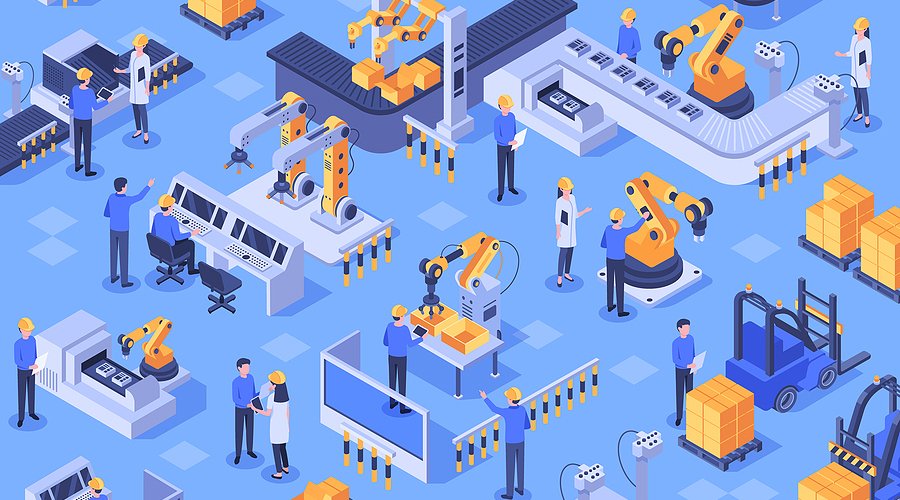
Walk into a modern manufacturing facility and you will see something very different from what factories looked like twenty or thirty years ago. There are robots welding car bodies with precision that no human hand could consistently replicate. There are conveyor systems that sort, route, and package products without a person touching them. There are computer systems monitoring hundreds of machines simultaneously, detecting subtle changes in performance before they become breakdowns. There are cameras inspecting products at speeds that make human quality inspection look impossibly slow by comparison.
This is automation in manufacturing and it is one of the most significant industrial transformations happening in the world right now. It is changing what factories look like, what they can produce, how much it costs to make things, and what skills the people who work in them need to have. It is creating enormous opportunities for manufacturers who embrace it and real challenges for those who are slow to adapt.
This blog is going to explain what automation in manufacturing actually means, the different types of automation being used today, the real benefits it delivers, the honest challenges it creates, what is happening in India specifically, and where the technology is heading. All of it in plain, accessible language that does not require an engineering degree to follow.
What Automation in Manufacturing Actually Means
The word automation covers a very wide range of things and it is worth being specific about what it actually means in a manufacturing context because the range goes from relatively simple to genuinely sophisticated.
At the most basic level, automation means using machines or technology to perform tasks that would otherwise require human labour. A conveyor belt that moves products from one workstation to the next is a simple form of automation. An industrial robot that performs a complex sequence of movements to assemble a product is a more sophisticated form. A computer system that monitors sensor data from hundreds of machines and automatically adjusts production parameters in real time is sophisticated automation of a different kind entirely.
Industrial automation broadly falls into a few categories. Fixed or hard automation refers to equipment designed to perform a single, specific task repeatedly. A dedicated stamping machine that produces one specific component is fixed automation. It is fast and efficient for high-volume production of a single item but cannot be easily changed to produce something different.
Programmable automation refers to equipment that can be reprogrammed to perform different tasks. Industrial robots are the most visible example. A robot arm that is programmed to weld car bodies can be reprogrammed to perform a completely different welding task on a different product by changing its programming rather than replacing the physical equipment.
Flexible or intelligent automation is the most advanced category and refers to systems that can adapt in real time to changing conditions, varying product specifications, or unexpected events. This is where artificial intelligence, machine learning, and advanced sensing combine with physical automation to create manufacturing systems that can genuinely respond to what is happening around them rather than just executing a fixed programme.
The Technologies Driving Manufacturing Automation
Several specific technologies are behind the transformation in manufacturing automation and understanding them separately helps build a clearer picture of what is actually changing.
Industrial robots have been part of manufacturing for decades but they have changed dramatically in recent years. Traditional industrial robots are large, fast, and powerful but they need to be isolated from human workers behind safety barriers because they cannot sense the people around them and would injure anyone in their path. Collaborative robots, known as cobots, are a newer category designed specifically to work alongside human workers in shared spaces. They have built-in sensors that detect nearby people and slow down or stop to avoid contact. Cobots are smaller, more affordable, and much easier to programme than traditional industrial robots, making automation accessible to smaller manufacturers who previously could not justify the cost.
Computer vision systems allow machines to see and interpret what they are looking at. In manufacturing, vision systems are used for quality inspection, where cameras and software examine products at high speed and identify defects that human inspectors would miss or catch inconsistently. They are also used to guide robots in picking and placing parts, in sorting products, and in reading barcodes and labels. The accuracy and speed of modern vision systems far exceed what human inspection can achieve in high-volume production environments.
The Industrial Internet of Things, commonly called IIoT, refers to the network of sensors, devices, and systems that collect data from manufacturing equipment and share it through connected networks. A machine fitted with IIoT sensors continuously reports its temperature, vibration levels, energy consumption, cycle times, and dozens of other parameters to a central monitoring system. This data enables predictive maintenance, where analysis of the sensor data identifies patterns that precede equipment failure and triggers maintenance before the breakdown happens rather than after.
Artificial intelligence and machine learning are being applied to manufacturing in ways that were not practically possible until recently. AI systems analyse production data to identify inefficiencies, optimise production schedules, predict quality issues before they reach the end of the production line, and continuously improve process parameters based on what the data shows. The ability to find patterns in the enormous amounts of data that modern manufacturing systems generate is where AI genuinely adds value that human analysis cannot match at the same scale.
Additive manufacturing, which is more commonly known as 3D printing, is an automation technology that builds parts by adding material layer by layer based on a digital design. While it is not the right approach for every product, additive manufacturing is transforming how prototypes are made, how complex custom parts are produced, and how manufacturers manage spare parts inventory. The ability to print a part on demand rather than stocking it physically has real supply chain implications.
The Real Benefits of Manufacturing Automation
The case for automation in manufacturing is strong when the benefits are honestly understood rather than oversimplified.
Consistency and quality improvement is one of the most important and most immediate benefits. Human workers, however skilled and experienced, vary in their performance over the course of a working day and working week. Fatigue, distraction, and the natural variability of human performance mean that products made at the start of a shift are not identical to products made at the end of one. Automated systems perform the same operation in exactly the same way thousands of times without variation. For products where consistency is critical, whether in medical devices, automotive components, electronics, or food production, this is enormously valuable.
Productivity and throughput improvements come from machines that can run continuously at speeds humans cannot match. An automated assembly line can produce far more units per hour than a manually operated one. When combined with the ability to run multiple shifts or even around the clock without the same labour cost implications of human overtime, automation creates production capacity that changes the economics of manufacturing significantly.
Safety improvement is a genuine and important benefit that sometimes gets less attention than productivity. Manufacturing environments contain many hazardous tasks, working with hot materials, heavy components, toxic substances, repetitive motions that cause injury over time, and confined spaces. Automating these tasks removes workers from harm. The industries with the highest rates of workplace injury are often the ones where automation has the most to offer in terms of safety improvement.
Cost reduction over time is the benefit most commonly cited and it is real, though the full picture is more nuanced than simply replacing expensive workers with cheaper machines. The initial investment in automation equipment is significant and the payback period needs to be carefully calculated. But over the life of properly implemented automation, the combination of higher throughput, reduced waste, lower defect rates, and reduced costs associated with workplace injuries and labour turnover typically produces a strong return on investment.
Data and insight generation is a benefit of modern automation that did not exist with older manufacturing technology. Every automated system in a modern factory generates data continuously. That data, properly collected and analysed, reveals inefficiencies that were previously invisible, identifies the root causes of quality problems, and provides the factual basis for continuous improvement decisions that make manufacturing operations progressively better over time.
The Honest Challenges Automation Creates
An honest discussion of manufacturing automation has to acknowledge the challenges it creates alongside the benefits. Ignoring these challenges does not make them disappear and it does not help manufacturers or workers navigate them constructively.
Workforce displacement is the most significant and most discussed challenge. Automation does reduce the need for certain types of labour, particularly repetitive manual tasks that machines can perform more efficiently. This creates real disruption for workers whose jobs are displaced and for communities where manufacturing employment has been a major source of livelihoods. How this displacement is managed, through retraining programmes, transitions to new roles within the same facilities, social safety net provisions, and thoughtful implementation timelines, determines whether automation’s economic benefits are broadly shared or narrowly concentrated.
The demand for new skills is the counterpart to workforce displacement. While automation reduces demand for some skills, it creates strong demand for others. Maintaining, programming, and optimising automated systems requires skills in robotics, software, data analysis, and engineering that are different from traditional manufacturing skills. Developing these skills in existing workers and in new entrants to the manufacturing workforce is both a challenge and an opportunity.
High initial investment costs create a genuine barrier for smaller manufacturers who may see the competitive necessity of automation but struggle to finance the capital investment required. This can create a widening gap between large manufacturers with access to capital and smaller ones without it, with real implications for the diversity and competitiveness of the manufacturing sector.
Cybersecurity risks associated with connected manufacturing systems are a growing concern. IIoT devices, connected robots, and networked production systems all create potential attack surfaces that did not exist when machines operated in isolation. Manufacturing companies that have not invested in cybersecurity alongside their automation investments are creating vulnerabilities that could be exploited with serious consequences for production continuity.
Manufacturing Automation in India
India is at an interesting and important moment in its relationship with manufacturing automation. The country has significant manufacturing ambitions expressed through initiatives like Make in India and Production Linked Incentive schemes across multiple sectors. It also has a large workforce for whom manufacturing employment is important economically.
The tension between automation-driven productivity improvement and the employment implications of that automation is particularly pronounced in the Indian context. Indian manufacturing needs to be competitive globally, which requires the productivity and quality improvements that automation delivers. At the same time, the workforce implications of rapid automation need to be managed thoughtfully given the scale of employment in the sector.
The sectors where automation adoption is most advanced in India include automotive manufacturing, where major domestic and international manufacturers have invested heavily in robot-assisted assembly and welding. Electronics manufacturing is another area of significant automation investment, driven partly by the PLI scheme encouraging large-scale electronics production. Pharmaceutical manufacturing, where quality and regulatory requirements create strong incentives for automation, has also seen substantial investment.
The opportunity for Indian manufacturers is to build automation capability progressively, focusing first on the areas where the quality and efficiency gains are most significant and where the return on investment is clearest. Starting with collaborative robots for specific tasks, deploying IIoT for predictive maintenance on existing equipment, and implementing vision-based quality inspection systems are all entry points that do not require the complete automation of an entire facility.
Where Manufacturing Automation Is Heading
The direction of manufacturing automation is toward greater intelligence, greater flexibility, and deeper integration between physical production systems and digital systems.
The concept of the smart factory or the digital factory describes a manufacturing environment where physical and digital systems are fully integrated, where production data flows continuously through every system, and where AI-driven optimisation operates across the entire facility rather than at individual machine level. Smart factories can respond to changing customer demand in near real time, reconfigure production lines for different products with minimal changeover time, and continuously optimise their own performance based on the data they generate.
Digital twins, which are detailed virtual models of physical manufacturing systems that are updated in real time with sensor data from the actual equipment, allow manufacturers to simulate changes, test new configurations, and identify potential problems in the virtual model before implementing anything in the physical facility. This dramatically reduces the risk and cost of changes to production systems.
Human and machine collaboration is a theme that runs through much of where the field is heading. Rather than complete replacement of human workers by machines, the most interesting developments involve humans and automated systems working together in ways that leverage the strengths of each. Machines bring consistency, speed, and data processing capability. Humans bring judgment, adaptability, creativity, and the ability to handle the unexpected. Designing manufacturing systems that combine these complementary strengths rather than trying to automate humans out completely is where the most thoughtful companies are focusing.
Conclusion
Automation in manufacturing is not a future possibility. It is a present reality that is reshaping how things are made across every industry and every country that takes manufacturing seriously. The technology is real, the benefits are documented, and the transformation is already well underway.
For manufacturers, the question is not whether to engage with automation but how to do so in a way that is strategic, financially sound, and thoughtful about the human implications. Starting with the applications that offer the clearest return on investment, building internal skills alongside technology implementation, taking cybersecurity seriously, and managing workforce transitions with genuine care are all part of doing this well.
For workers, understanding where automation is heading in their industry and proactively developing the skills that work alongside automated systems rather than competing with them is the most important career strategy available. The skills that are in growing demand in automated manufacturing, data analysis, robot programming, systems monitoring, and continuous improvement, are learnable and are increasingly taught in accessible formats.
For policymakers and society more broadly, the challenge is ensuring that the productivity gains from manufacturing automation are shared broadly enough to make the transition sustainable and fair. Investment in retraining, strengthening educational pathways into technical roles, and building social support systems that ease difficult transitions are all part of the policy response that automation requires.
Manufacturing automation is genuinely one of the most important economic and industrial stories of our time. Understanding it clearly is the first step toward navigating it well, whether you are a manufacturer, a worker, an investor, or simply someone who wants to understand the world that is being built around us.
The factories of the future are being built today. The question is whether we shape that future deliberately or simply arrive in it unprepared.