
We have all been there. You are driving down the highway, singing along to the radio, and suddenly your car makes a terrible clunking noise. Steam pours out from under the hood, and you are stuck on the side of the road waiting for a tow truck. It is frustrating, it is expensive, and it ruins your entire day. Now, imagine that same situation, but instead of a car, it is a giant machine in a factory that makes thousands of dollars every hour. If that machine stops, the business loses a fortune.
This is the nightmare that every business owner and facility manager tries to avoid. We rely on machines for almost everything in our modern lives. They keep our lights on, they make our food, and they build our cars. But machines are not immortal. They have moving parts that wear out, belts that snap, and oils that get dirty. If you ignore them, they will break. The question is not if they will break, but when.
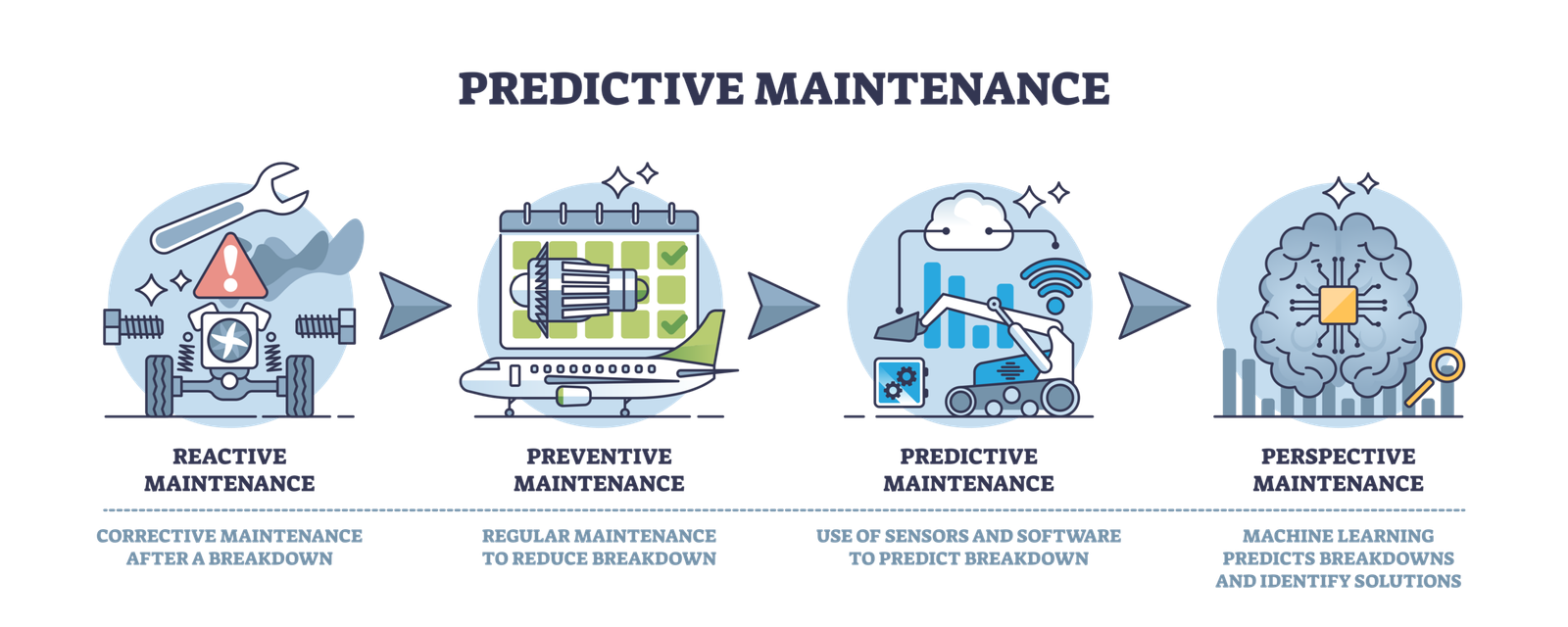
This is where maintenance comes in. For a long time, people just fixed things when they broke. This is called reactive maintenance, and it is a terrible way to run a business. Today, we have smarter strategies. The two big champions of the maintenance world are Preventive Maintenance and Predictive Maintenance. These terms might sound like technical jargon, but they are actually very simple concepts that can save you time, money, and a lot of headaches. This guide is going to walk you through exactly what they are, how they differ, and which one is right for you, all in simple, plain English.
The Hidden Cost of Broken Machines and Downtime
Before we talk about the solutions, let’s talk about the problem. Why do we care so much about maintenance? The answer is “Downtime.” Downtime is the period when a machine is broken and cannot do its job. In a factory, this means production stops. Workers are standing around getting paid to do nothing. Orders are not being filled. Customers are getting angry.
But the cost of a breakdown is more than just lost time. It is also about the cost of the repair itself. Emergency repairs are always more expensive than planned repairs. You have to pay extra for rush shipping on parts. You might have to pay overtime for a mechanic to come in on a Sunday night. There is also the safety risk. When machines break unexpectedly, they can hurt people. A belt snapping at high speed or a boiler exploding because a valve failed are dangerous situations.
This is why companies are moving away from the “run-it-until-it-breaks” mentality. They are realizing that spending a little bit of money now to keep machines healthy saves a massive amount of money later. It is the same logic as brushing your teeth. You brush them every day (preventive) so you don’t have to get a painful root canal later (corrective). Maintenance is the hygiene of the industrial world.
Understanding Preventive Maintenance: The Scheduled Check-Up
Preventive Maintenance, often called PM, is the classic approach. It is based on the calendar or usage. You pick a schedule, and you stick to it, no matter what. Think about your car. The manual says to change the oil every 5,000 miles. You don’t wait for the engine to start smoking; you just do it because you hit the 5,000-mile mark. That is preventive maintenance.
In a business setting, this involves creating a checklist. Every Monday, you might grease the bearings. Every month, you might change the air filters. Every year, you might take the machine apart and replace all the seals. You do these tasks whether the machine looks like it needs them or not.
The logic here is based on averages. Manufacturers know that a fan belt usually lasts for about 10,000 hours of spinning. So, to be safe, they tell you to replace it at 9,000 hours. You are replacing it before it has a chance to fail. It is a conservative, safe strategy. You are trading the cost of the part for the peace of mind that it won’t break unexpectedly. It is systematic, organized, and relatively easy to manage because you can plan your budget and your schedule months in advance.
Why Preventive Maintenance is the Safe Choice
There is a reason why Preventive Maintenance has been the standard for decades. It works. By regularly checking and cleaning your equipment, you extend its life significantly. You catch small problems, like a loose screw or a fraying wire, before they turn into big problems that destroy the whole machine.
One of the biggest benefits is scheduling. If you know you need to shut down a machine for maintenance, you can do it at a convenient time. You can do it at night when the factory is closed, or during a slow season. This minimizes the impact on your business. You control the machine; the machine does not control you.
It also helps with compliance. Many industries have strict safety rules. Elevators, for example, must be inspected regularly by law. Preventive maintenance ensures you pass these inspections and avoid fines. It keeps your warranty valid, too. If a machine breaks and you try to claim the warranty, the manufacturer will often ask for proof that you maintained it properly. If you have a log of all your PM tasks, you are covered. It is a strategy that prioritizes reliability and safety above everything else.
Understanding Predictive Maintenance: Listening to Your Machines
Now, let’s look at the newer, smarter sibling: Predictive Maintenance (PdM). While Preventive Maintenance looks at the calendar, Predictive Maintenance looks at the actual machine. It asks, “How are you feeling today?”
Imagine you go to the doctor. Preventive maintenance is like getting a physical exam once a year even if you feel fine. Predictive maintenance is like wearing a smart watch that monitors your heart rate 24/7. If your heart rate spikes while you are sitting on the couch, the watch alerts you that something is wrong right now.
Predictive maintenance uses data. We install sensors on machines to measure things like vibration, temperature, and sound. A healthy motor hums quietly. A motor with a bad bearing vibrates and gets hot. The sensor detects this change instantly. It sends an alert to the computer saying, “Hey, this motor is vibrating more than usual. It’s going to break in about two weeks.” This allows you to fix it at the perfect moment—right before it fails, but not too early when the part is still good. It eliminates the guesswork.
How Technology Makes Predictive Maintenance Possible
Predictive maintenance sounds like magic, but it is just technology. The core of this strategy is the “Internet of Things” (IoT). This is a fancy way of saying that everyday objects are connected to the internet. In a factory, machines are connected to a central computer system.
The most common tool is vibration analysis. Rotating machines, like pumps and fans, have a specific “fingerprint” of vibration when they are running smoothly. When a part starts to wear out, that fingerprint changes. Sensors can detect tiny wobbles that a human hand could never feel.
Another tool is thermal imaging. Electrical parts usually get hot before they fail. If you look at a fuse box with your eyes, everything looks normal. But if you look at it with a thermal camera, a loose connection will glow bright red because of the heat. Ultrasonic analysis is another cool technique. It listens for high-frequency sounds that humans can’t hear. A gas leak, for example, makes a hissing sound in the ultrasonic range long before a human can hear it. By using these high-tech ears and eyes, we can catch problems that are invisible to the naked eye.
The Big Showdown: Preventive vs. Predictive Maintenance
So, what is the real difference? It comes down to “Just in Case” versus “Just in Time.”
Preventive Maintenance is “Just in Case.” You change the oil just in case it is dirty. You replace the belt just in case it is worn out. The downside of this is waste. You might throw away a belt that still had six months of life left in it. You are spending money on parts and labor that you didn’t strictly need to spend yet. You are also shutting down the machine more often than necessary to do these checks.
Predictive Maintenance is “Just in Time.” You only change the oil when the sensor says it is dirty. You only replace the belt when the vibration data shows it is cracking. This is incredibly efficient. You get every single penny of value out of your parts. You also reduce labor because you aren’t sending mechanics to check on healthy machines. However, the downside is the setup cost. You have to buy the sensors, the software, and train your staff to read the data. It is a bigger investment upfront for a bigger saving later.
Which Maintenance Strategy is Right for Your Business?
You might be thinking, “Predictive sounds better, so I should just do that.” Not necessarily. The best strategy depends on your specific situation. It is rarely an all-or-nothing choice. Most smart companies use a mix of both.
For cheap, easy-to-replace items, Preventive Maintenance is often better. Think about lightbulbs. You don’t need a high-tech sensor to tell you a lightbulb is about to burn out. You just change them all once a year, or wait for them to flicker. It is not worth the cost of the sensor. The same goes for air filters. It is cheaper to just change them on a schedule than to install pressure sensors to monitor airflow.
However, for critical, expensive machines, Predictive Maintenance is the winner. If you have a giant turbine that powers your whole factory, you cannot afford for it to stop unexpectedly. And you also don’t want to shut it down unnecessarily for inspections because that costs money too. Putting sensors on that turbine makes sense. The savings from preventing one catastrophic failure will pay for the sensors ten times over. You have to weigh the “Cost of Failure” against the “Cost of Monitoring.”
Real-World Examples of Maintenance Success Stories
Let’s look at a real-world example to see how this works. Imagine a large commercial bakery. They have massive ovens and mixers that run 24 hours a day to bake bread.
In the old days, they used Preventive Maintenance. Every Saturday, they would shut down the mixers to grease the gears and check the belts. This meant they couldn’t bake bread on Saturdays. Sometimes, a belt would snap on a Wednesday anyway, causing a panic. They were doing their best, but they were still losing production time.
Then, they switched to Predictive Maintenance. They put vibration sensors on the mixer motors and temperature sensors on the ovens. The data showed that the belts actually lasted much longer than they thought. They stopped doing the Saturday shutdowns. Instead, they watched the dashboard. One Tuesday, the system alerted them that Mixer #3 was vibrating oddly. They kept it running until the shift ended, then swapped the bearing in 30 minutes. They saved the Saturday production time, they stopped wasting good parts, and they never had a surprise breakdown again. The bakery became more profitable just by changing how they listened to their machines.
The Future of Maintenance is Smart and Automated
We are entering a new era called Industry 4.0. This is the time of smart factories and Artificial Intelligence (AI). In the future, maintenance will become even more automated. We are moving from “Predictive” to “Prescriptive.”
Predictive tells you, “This machine is going to break.” Prescriptive tells you, “This machine is going to break, and here is exactly how you should fix it.” The computer will automatically order the spare part from the supplier. It will automatically schedule the mechanic. It might even adjust the machine’s speed to keep it running safely until the part arrives.
We are also seeing the rise of “Digital Twins.” This is where you create a virtual computer model of your real machine. You can run tests on the digital twin to see what happens. You can simulate a heatwave to see if the machine will overheat. This helps you plan for extreme conditions without risking the real equipment. Augmented Reality (AR) is also entering the field. Mechanics can wear smart glasses that project the repair manual right onto the machine they are looking at, showing them exactly which bolt to turn. The future of maintenance is less about grease and wrenches, and more about data and software.
Conclusion: Taking Control of Your Equipment Health
At the end of the day, maintenance is about control. Do you want to control your equipment, or do you want your equipment to control you? If you do nothing (reactive maintenance), you are always in a state of emergency. You are stressed, losing money, and fighting fires.
By adopting Preventive Maintenance, you gain stability. You have a schedule. You have peace of mind knowing that you are taking care of the basics. It is a solid, reliable foundation for any business. By stepping up to Predictive Maintenance, you gain efficiency. You stop guessing and start knowing. You optimize your spending and maximize your uptime.
You don’t have to transform your whole business overnight. Start small. Look at your most critical machine—the one that causes the most pain when it breaks. Could you put a simple sensor on it? Could you create a better checklist for it? Every step you take away from reactive maintenance is a step toward a more profitable, safer, and calmer workplace. Your machines are the heart of your operation. Listen to them, take care of them, and they will take care of you.