When you wake up in the morning and flip the light switch, the room instantly brightens. You plug in your phone, and it starts charging. You turn on the coffee maker, and hot water drips into the pot. We do these things every single day without thinking about them. It feels like magic, but it is actually the result of massive, complex systems working 24 hours a day to keep our lives running. Energy is the invisible lifeblood of modern civilization. Without it, our cities would go dark, our food would spoil, and our communication would stop.
For over a century, we burned things to make power. We burned wood, then coal, then oil and gas. It worked, but it came with a heavy cost to our planet. Now, in 2026, we are living through the biggest change in energy history since the invention of the steam engine. We are moving from digging fuel out of the ground to catching it from the sky and the wind. This transition is not just about saving the environment; it is about new technology that is cheaper, cleaner, and smarter. This guide is going to walk you through the fascinating world of energy and power technologies. We will strip away the complex engineering terms and use simple, plain English to explain how we generate electricity today and how we will power the world tomorrow.
The Basics of Traditional Power: Understanding Fossil Fuels
To understand where we are going, we first have to understand where we came from. For most of the last 100 years, the world ran on fossil fuels: coal, oil, and natural gas. These are essentially ancient sunlight stored in the ground. Millions of years ago, plants and dinosaurs died and were compressed by the earth into energy-dense rocks and liquids.
The way we use them is simple: we burn them. In a traditional power plant, we burn coal to boil water. The boiling water turns into steam. The high-pressure steam pushes against the blades of a giant fan called a turbine. The turbine spins a magnet inside a coil of wire, which creates electricity. It is surprisingly simple technology, very similar to a tea kettle, just on a massive scale.
Fossil fuels were great because they were reliable. You could burn coal day or night, rain or shine. But they have two big problems. First, they are finite; eventually, we will run out. Second, burning them releases carbon dioxide and other pollutants that trap heat in our atmosphere, causing climate change. Because of this, the world is moving away from burning rocks and toward technologies that work with the planet rather than against it.
The Rise of Solar Energy: Harnessing the Power of the Sun
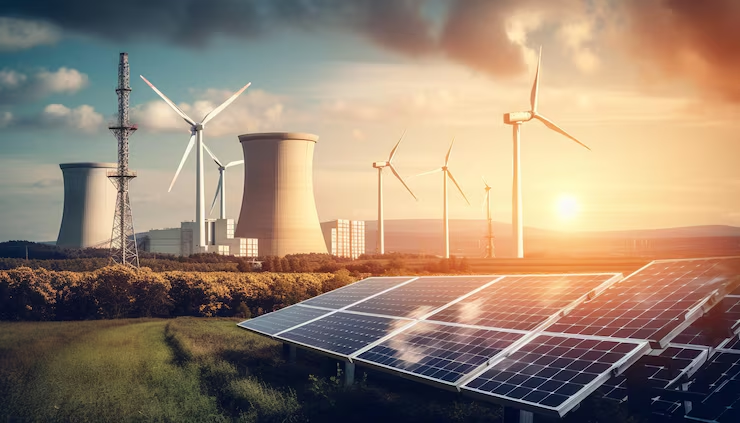
If you look up at the sky on a clear day, you are looking at the biggest nuclear reactor in our solar system. The sun hits the Earth with enough energy every single hour to power the entire human race for a year. The challenge has always been catching that energy. This is where solar panels come in.
Solar panels are made of silicon, the same material used in computer chips. When sunlight hits a solar panel, it knocks electrons loose from the silicon atoms. These electrons flow through wires, creating direct current (DC) electricity. This is called the “photovoltaic effect.” In the past, solar panels were incredibly expensive and not very efficient. They were only used for satellites in space or calculators.
Today, solar is one of the cheapest forms of electricity in history. We have massive solar farms in deserts that stretch for miles. We have panels on the roofs of houses, schools, and supermarkets. We even have “building-integrated photovoltaics,” which are windows or roof tiles that generate power while looking like normal building materials. The beauty of solar is that it has no moving parts. It sits there silently, eats sunlight, and spits out electricity. It democratizes energy, allowing a homeowner to generate their own power instead of buying it all from a big utility company.
Wind Power Technology: Catching the Breeze for Clean Electricity
Wind energy is actually just another form of solar energy. The sun heats the earth unevenly—the equator gets hot, the poles stay cold—and this temperature difference causes air to move. We call that movement wind. For thousands of years, humans used windmills to grind grain. Today, we use wind turbines to make electricity.
A modern wind turbine is a marvel of engineering. They are giants. A single blade can be longer than a football field. When the wind blows, it lifts the blade (just like an airplane wing), causing the rotor to spin. This spinning motion turns a generator inside the box at the top of the tower (the nacelle).
We are seeing two types of wind power: Onshore and Offshore. Onshore wind farms are the ones you see in fields while driving down the highway. They are cheap and easy to build. Offshore wind farms are built in the middle of the ocean. The wind out at sea is much stronger and more consistent than on land. These turbines are massive, standing hundreds of feet tall above the waves. They are harder to build because of the saltwater and storms, but a single offshore turbine can power thousands of homes. Wind is clean, free, and infinite. As long as the earth spins and the sun shines, the wind will blow.
Hydroelectric Power: Using Water Gravity to Light Our Homes
Water is heavy. If you have ever carried a bucket of water, you know this. When water falls from a high place to a low place, it carries a lot of energy. This is the principle behind hydroelectric power, the oldest and largest source of renewable energy.
The classic example is a dam. We build a giant concrete wall across a river, creating a lake (reservoir) behind it. We open a small gate at the bottom of the dam. The weight of the water in the lake pushes water through the gate at incredible pressure. This rushing water spins a turbine, which generates electricity. It is very similar to wind power, but water is much denser than air, so it packs a bigger punch.
Hydro is fantastic because it acts like a giant battery. If we need more power (like when everyone turns on their TVs for the Super Bowl), the dam operators just open the gates wider. If we need less, they close them. However, building dams floods huge areas of land and can hurt fish populations. Because of this, we are seeing new “run-of-river” hydro systems that don’t need big dams. They just divert a small part of the river through a pipe to spin a turbine and then return it to the stream. We are also experimenting with tidal power, putting turbines underwater to catch the energy of the ocean tides moving in and out twice a day.
The Nuclear Question: Clean Energy or Dangerous Waste?
Nuclear energy is the most controversial topic in the power industry. Some people see it as the only way to save the climate; others see it as a ticking time bomb. To understand it, you have to look at the science. Nuclear plants don’t burn anything. Instead, they use uranium atoms.
When you split a uranium atom (a process called fission), it releases a massive amount of heat. We use that heat to boil water, make steam, and spin a turbine. It is zero-emission. No smoke, no carbon dioxide. A tiny pellet of uranium the size of a gummy bear has as much energy as a ton of coal. It is incredibly dense and reliable power that works 24/7.
The problem, of course, is the waste. The used fuel remains radioactive for thousands of years, and we have to store it safely. There is also the fear of accidents, like Chernobyl or Fukushima. However, in 2026, technology is changing. Engineers are building “Small Modular Reactors” (SMRs). These are tiny, factory-built nuclear plants that are designed to be “walk-away safe.” If the power goes out, they cool themselves down automatically using gravity and physics, making a meltdown physically impossible. Many experts believe these safer, smaller plants are necessary to provide steady power when the sun isn’t shining and the wind isn’t blowing.
Energy Storage Solutions: The Battery Revolution Changing Everything
The biggest criticism of renewables is reliability. Critics ask, “What happens when the sun sets? What happens when the wind stops?” For a long time, this was a valid point. You had to keep a coal or gas plant running in the background just in case. But now, we have the solution: Batteries.
Energy storage is the Holy Grail of modern power. We are seeing massive “grid-scale” batteries being built. These look like rows of shipping containers parked next to a solar farm. During the day, when the sun is bright and electricity is cheap, the solar panels charge the batteries. At night, when everyone gets home and turns on their lights, the batteries discharge that stored power back into the grid.
Most of these are Lithium-Ion batteries, the same technology in your laptop and phone, just much bigger. But we are also seeing new chemistries. “Flow batteries” use giant tanks of liquid electrolytes to store power for days. “Gravity batteries” use excess power to lift heavy concrete blocks up a tower, and then drop them back down to spin a generator when power is needed. Storage breaks the link between when energy is made and when it is used, making renewable energy reliable 24 hours a day.
The Smart Grid: How the Internet is Fixing Our Power Lines
Our current electrical grid was designed 100 years ago. It was a “one-way” street. Power flowed from the big plant to your house, and that was it. If a tree fell on a line, the power company didn’t know until you called them to complain. Today, we are building the “Smart Grid.”
The Smart Grid is the “Internet of Energy.” It uses digital technology to create a two-way conversation between the utility and the customer. It starts with a Smart Meter on your house. This meter tells the power company exactly how much energy you are using in real-time.
But it goes deeper. The Smart Grid uses sensors on power lines to detect faults instantly. It can automatically reroute power around a broken line to keep the lights on, a process called “self-healing.” It also helps balance the load. In the future, your dishwasher might talk to the grid. The grid could tell your dishwasher, “Hey, power is really expensive right now because it’s hot and everyone is running AC. Wait until 2:00 AM to run the cycle when wind power is cheap.” This intelligence makes the whole system more efficient and prevents blackouts.
Hydrogen Fuel Cells: The Cleanest Fuel for the Future
Batteries are great for cars and houses, but they are heavy. You can’t run a cruise ship or a jumbo jet on batteries; they would be too heavy to move. For heavy industry, we need a fuel that burns, but burns clean. Enter Hydrogen.
Hydrogen is the most common element in the universe. When you run electricity through water, you can split the H2O into Hydrogen and Oxygen. If you use solar or wind power to do this, it is called “Green Hydrogen.” It is essentially bottled wind or bottled sunshine.
You can burn hydrogen in an engine, or you can run it through a “Fuel Cell.” A fuel cell mixes hydrogen with oxygen from the air to create electricity. The only exhaust that comes out of the tailpipe is pure water vapor. You can drink it. We are starting to see hydrogen-powered trains, trucks, and ferries. It allows us to keep the convenience of liquid fuel—filling up a tank in five minutes—without the pollution of diesel or gasoline. It is expensive right now, but it is viewed as the final piece of the clean energy puzzle.
Bioenergy and Geothermal: Earth’s Natural Heat and Fuel Sources
Solar and wind get all the headlines, but the earth itself has energy we can use. Geothermal energy taps into the heat beneath our feet. The center of the Earth is as hot as the surface of the sun. If you drill down deep enough, you hit hot rocks and water.
In places like Iceland or California, they pipe this hot steam up to the surface to spin turbines. It is free, constant, clean power. New drilling technologies from the oil industry are allowing us to drill deeper and hotter wells almost anywhere, not just near volcanoes. This is called “Enhanced Geothermal Systems.”
Then there is Bioenergy. This is energy from organic matter. It includes wood, crop waste, and even trash. We can burn these to make electricity, or we can use bacteria to ferment them into “biogas” (like natural gas) or liquid biofuels for airplanes. The idea is that the plants absorbed carbon dioxide while they grew, so burning them is carbon-neutral. It is a way to turn our waste—like corn stalks or landfill garbage—into useful power.
The Future of Energy: Transitioning to a Sustainable World
We are standing at a crossroads. The transition from the old world of fossil fuels to the new world of clean technology is happening fast, but it is a massive challenge. It requires rebuilding the entire infrastructure of the planet. It means replacing billions of cars, refitting millions of homes, and constructing thousands of new power plants.
But the future looks bright. Energy is becoming “decentralized.” Instead of one giant plant powering a city, we will have millions of solar panels, wind turbines, and batteries all working together. It is becoming “electrified.” We are switching our cars, our stoves, and our heaters from gas to electricity. And it is becoming “digital.” Artificial intelligence will manage the flow of electrons to make sure every watt is used efficiently.
This isn’t just about technology; it is about our quality of life. The energy systems of the future will give us cleaner air to breathe, cheaper bills to pay, and a stable climate to live in. The hum of a wind turbine and the shine of a solar panel are the symbols of a world that has learned to power itself without destroying its home. It is an exciting time to be alive, watching the wires and gears of civilization get an upgrade for the 21st century.